
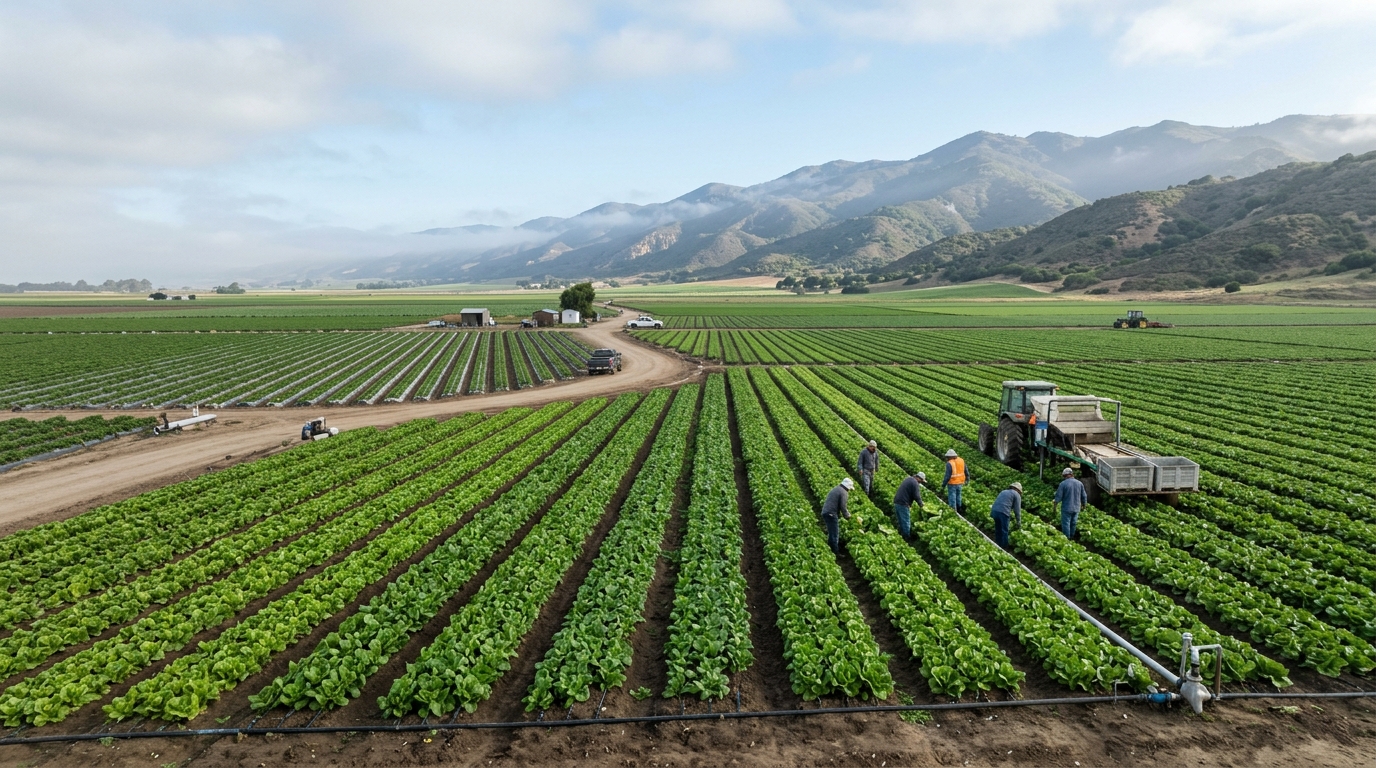
Monterey County’s 2025 Crop and Livestock Report gives Salinas residents a useful snapshot of what was grown, how major commodities changed and where agricultural production value was concentrated during the year. Released on July 7, 2026, the report placed the county’s total gross agricultural production value at $4,822,429,000. That was a 3% decline from the record reported for 2024, but it still reflects the enormous scale of farming across the Salinas Valley and the rest of Monterey County.
The headline numbers are striking. Strawberries remained the county’s most valuable individual commodity at $1,068,736,000. Leaf lettuce reached $1,001,018,000, crossing the billion-dollar level for the first time, while head lettuce contributed another $583,706,000. Broccoli ranked fourth at $516,030,000. Together, lettuce and leafy-green production accounted for roughly one-third of the county’s total reported value.
Those figures help explain why agriculture shapes so much of everyday life in Salinas, from employment and traffic patterns to land use, water debates, food businesses and the identity of the region. However, the report is easy to misunderstand if the dollar values are read as profits. This guide explains what the newest numbers show, what they do not show and how residents can use the report as a starting point for understanding the local economy. More coverage will be collected in the Salinas agriculture and innovation guide.
The Biggest Takeaways From the 2025 Crop Report
The 2025 report confirms that Monterey County agriculture remains heavily centered on high-value specialty crops. Vegetables generated about $3.3 billion, even after the category declined by 4% from the previous year. Fruits and nuts were valued at about $1.25 billion, a decrease of approximately 1%. Field crops and seed crops increased, while livestock and poultry declined.
The crop ranking also shows how concentrated the county’s agricultural value is near the top. The first four commodities—strawberries, leaf lettuce, head lettuce and broccoli—represented more than $3.1 billion in gross value. Cauliflower, celery, spinach, nursery products and flowers, wine grapes, and livestock and poultry completed the county’s reported top 10.
Strawberries and Lettuce Passed Major Milestones
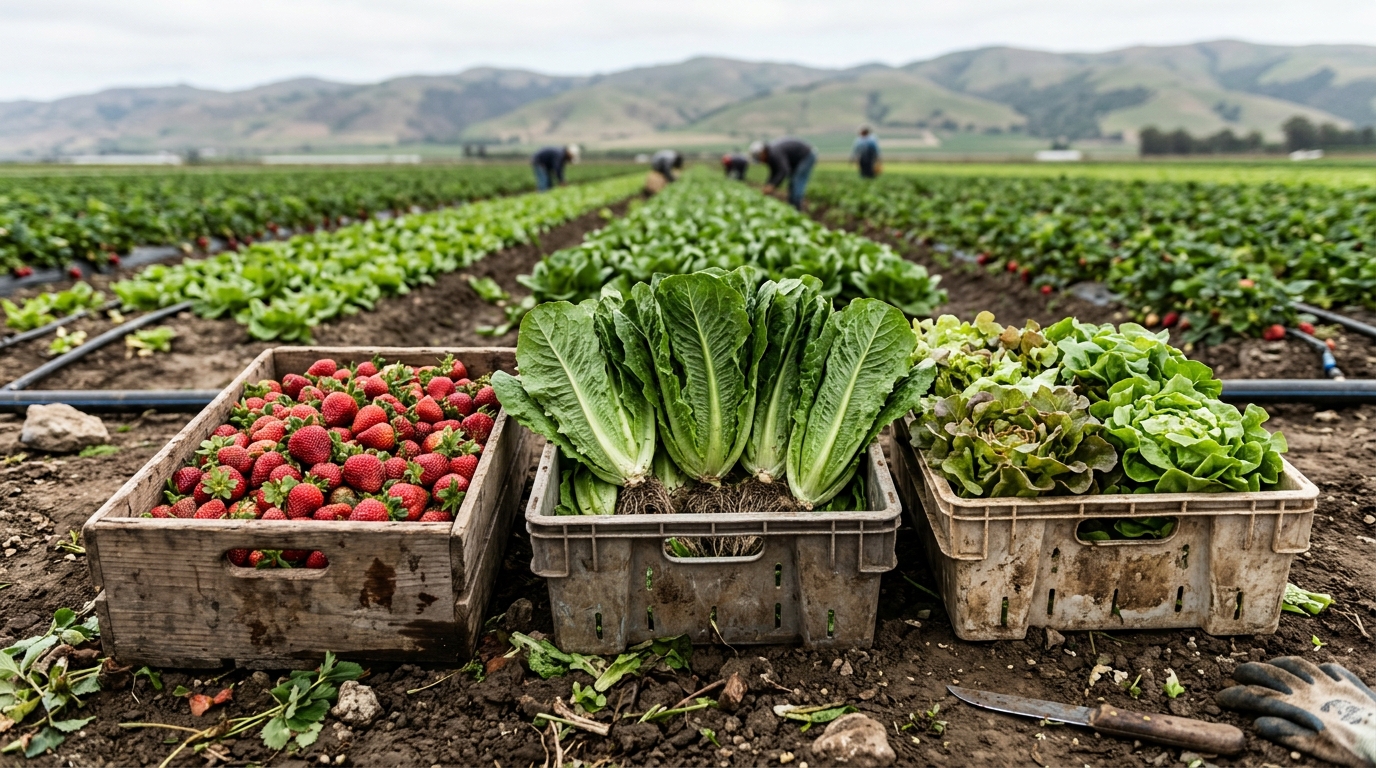
Strawberries held the top position for the fifth consecutive year and increased 3% from 2024. Leaf lettuce, including romaine and other leaf varieties, increased 7% and moved above $1 billion. Head lettuce declined 2%, but its $583.7 million value still placed it well ahead of most other individual commodities.
Why Two Billion-Dollar Crops Matter
Having two individual commodities valued above $1 billion shows the scale and specialization of Monterey County farming. It also illustrates how strongly the regional economy depends on consumer demand, distribution networks and the continued ability to grow labor-intensive fresh produce. A disruption affecting strawberries or lettuce can therefore extend beyond the field to cooling facilities, trucking, packaging, food processing, equipment suppliers and household income.
For local readers, the numbers offer a more accurate picture than the familiar “Salad Bowl” nickname alone. The valley does not simply grow a wide assortment of produce; it produces certain crops at a scale that can influence national supply. The County of Monterey crop-report archive provides the official report and previous editions for year-to-year comparison.
Vegetables Still Dominate, but Not Every Crop Increased
Broccoli remained the fourth-highest commodity at $516 million, yet its value fell 11%. The report and subsequent agricultural coverage identified pest and disease pressure among the difficulties affecting some vegetable crops. Cauliflower, celery and spinach stayed in the top 10, but the broader vegetable category still finished below its 2024 value.
Wine grapes experienced one of the most visible declines. Their gross value fell 25% to $114,603,000, placing wine grapes ninth in the county ranking. The reported causes included oversupply, reduced demand and lower yields connected with unharvested acreage. That does not mean every vineyard or winery experienced the same result, but it shows why a countywide total should not be treated as a description of every individual operation.
Residents interested in the connection between farms and local eating can also explore the future Salinas food and drink guide. That section will focus on verified businesses, seasonal context and the agricultural stories behind local food without claiming that every locally sold product was grown in Monterey County.
Organic Agriculture Now Represents a Larger Share
The theme of the 2025 report is “25 Years of Organics.” County figures place organic agricultural value at $849.6 million in 2025, compared with $335.1 million in 2015. Organic production represented about 18% of the county’s total agricultural value.
This growth is important, but the term “organic” has a specific regulatory meaning. It does not simply refer to a farm using fewer chemicals or following a general environmental philosophy. Organic operations must meet federal standards, maintain records and participate in certification and enforcement systems. The report’s anniversary theme emphasizes the development of that regulated structure over the past quarter-century.
Organic Value Does Not Answer Every Sustainability Question
The organic total shows market value, not a complete environmental score. It does not by itself measure groundwater conditions, energy use, soil health, labor conditions, packaging, food waste or transportation impacts. Conventional and organic farms can also differ widely in management practices. Readers should therefore avoid using one label as a shortcut for judging an entire operation.
A more useful approach is to ask specific questions. How is water monitored? What pest-management tools are used? How are workers trained and protected? What happens to unsold produce? Which conservation programs are documented? Future reporting in the Agriculture and Innovation category will separate verified practices from broad sustainability claims.
How Salinas Residents Should Read the Dollar Figures
The most important limitation is printed directly into crop-report explanations: gross production value is not profit. The figures estimate the value of commodities produced in the county before subtracting the cost of growing, harvesting, cooling, packing, transporting and marketing them. They also do not subtract labor expenses, machinery, fertilizer, water, pest management, insurance, regulatory compliance, land costs or losses experienced by individual operations.
This distinction matters because a crop can post a high gross value while growers face thin or negative margins. Production costs differ by crop, location, season, labor needs, market agreement and farming method. A billion-dollar commodity is economically significant, but the number does not mean a billion dollars was available to owners, workers or local governments after expenses.
The Report Is a Starting Point, Not a Complete Economic Study
Crop reports are valuable because they use a consistent annual format and allow readers to compare commodities over time. They can show whether acreage, yield, price or total value moved up or down. Also reveal larger shifts, such as the growth of organic production or a sharp decline in wine-grape value.
They are less useful for answering questions about wages, household prosperity, food affordability or the total number of jobs supported throughout the supply chain. Those questions require additional labor, business and economic-contribution data. The county publishes a separate economic-contributions report, while the USDA National Agricultural Statistics Service provides statewide agricultural data that can help place local commodities in a broader California context.
Practical Ways to Use the Report Locally
Residents can use the report to identify which agricultural topics deserve closer reporting. A major change in value can lead to questions about planted acreage, weather, disease, labor availability, tariffs, consumer demand or production cost. The report should not be used to guess at the finances of a particular farm or to claim that one difficult year proves a long-term trend.
Teachers and students can compare several annual reports rather than relying on a single year. Consumers can use crop-season information to better understand when locally grown produce is likely to be available, while recognizing that retailers source from many regions. Job seekers can learn which parts of the agricultural system extend beyond field work, including food safety, equipment, research, logistics, cooling, packaging and technology.
Local-history readers can connect current rankings with the longer evolution of the Salinas Valley through the Salinas local-history section. For another example of how Salinas Stories separates confirmed public information from assumptions, read the guide to the Closter Park revitalization.
The 2025 crop report ultimately tells a mixed story. Monterey County agriculture remained extraordinarily valuable, strawberries and leaf lettuce reached notable totals, and organic production represented a larger share of the county’s output. At the same time, total value declined, several commodities lost ground and rising production costs remained a serious limitation behind the headline numbers. The clearest conclusion is not that agriculture had a simply “good” or “bad” year. It is that the Salinas Valley remains highly productive, economically complex and dependent on conditions that can change quickly.
Salinas Stories will use the county report as a foundation for more specific coverage rather than as the final word. Readers can review our sources and fact-checking policy to see how changing figures, proposals and official records will be handled.